2026-10-02 · Dale Harlan
Can Spray Foam Help Prevent Condensation in Metal Buildings?
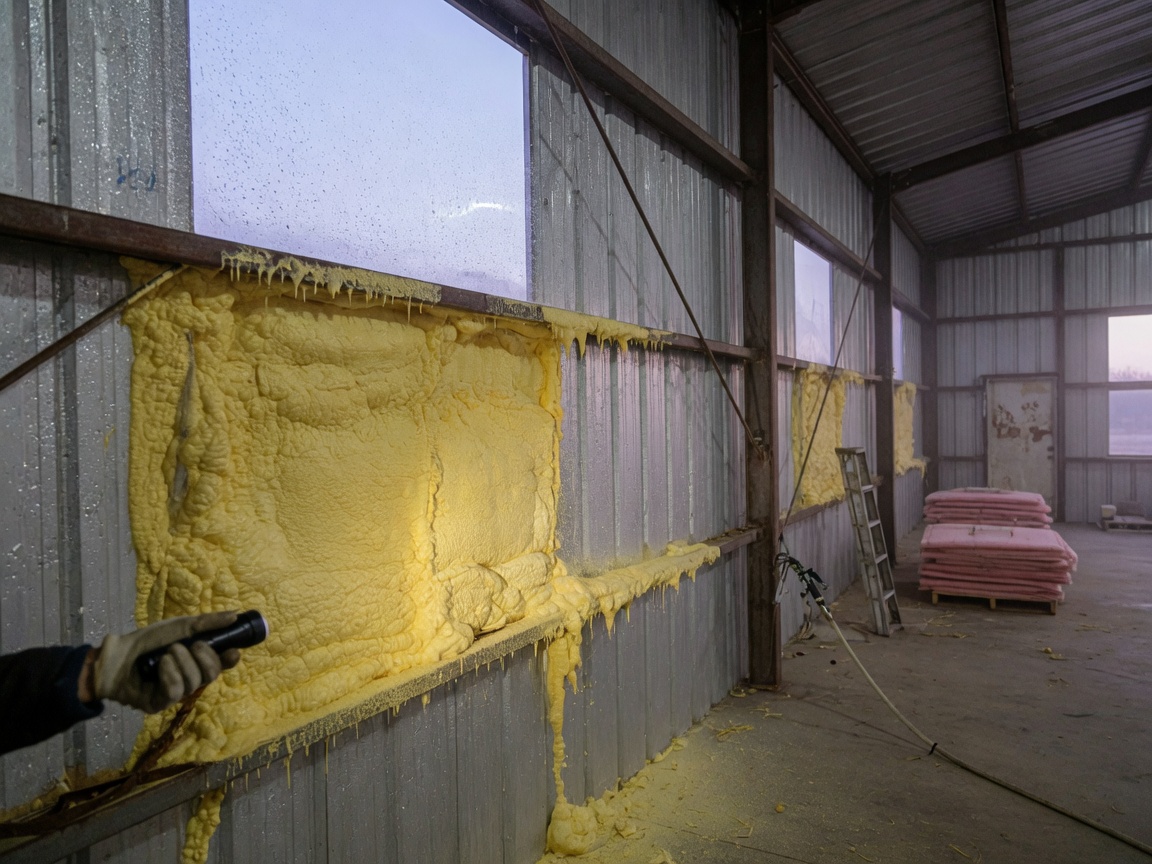
Yes, closed-cell spray foam prevents condensation in metal buildings when applied at 2 inches or greater thickness, forming an air-impermeable layer that keeps interior panel surfaces above the dew point even during Sand Springs humid subtropical summers and mild winter temperature drops.
How Condensation Develops on Metal Panels
Metal buildings in Prattville and near Keystone Lake experience rapid temperature swings because thin steel conducts heat quickly. When warm, moisture-laden air from the humid subtropical climate contacts cooler interior surfaces during overnight cooling or mild winter days, water vapor condenses on the metal. This process repeats daily in structures used for storage, workshops, or light commercial work around Sand Springs Heights. Over time, repeated wetting corrodes panels, damages stored equipment, and promotes mold on any adjacent wood or drywall. The county's proximity to Keystone Lake adds localized humidity that accelerates the cycle compared with drier parts of Oklahoma. Proper insulation must address both the conductive metal and the persistent moisture load rather than simply adding R-value.
Why Closed-Cell Spray Foam Stops the Cycle
Closed-cell spray foam adheres directly to metal, eliminating air gaps where condensation forms. At 2 inches it delivers roughly 13 R-value and creates a vapor barrier with permeability below 1 perm, blocking the movement of humid air to cold surfaces. In Sand Springs applications, crews typically apply 2–3 inches on walls and 3–4 inches on roofs to handle peak summer dew points. Unlike fiberglass or rigid boards, the foam expands into seams, fasteners, and corrugations, sealing the entire envelope. This approach works on both new and existing metal buildings in Tulsa County without requiring interior liners in many cases. The material also adds structural rigidity, which helps older buildings near Mannford withstand wind loads common along the lake corridor.
Local Climate and Building Factors in Sand Springs
Sand Springs summers push daytime highs above 90°F with high relative humidity, while winter nights can drop into the 20s. These swings create dew-point conditions inside uninsulated metal buildings for weeks each year. Structures in Prattville often sit on slab foundations with minimal ventilation, trapping moisture released from stored materials or equipment. Buildings near Sand Springs Heights face additional runoff and soil moisture that can migrate through slab edges. Spray foam applied at the base of walls and along the roof deck interrupts both air and vapor paths. Crews from 8635 W 21st St schedule work during shoulder seasons to avoid extreme heat that affects foam yield and cure times.
Application Steps for Existing Metal Buildings
- Inspect for active leaks and corroded panels before any foam work.
- Clean surfaces to remove dust, oil, and loose scale so adhesion reaches full strength.
- Mask doors, windows, and electrical boxes to protect finishes.
- Apply closed-cell foam in 1.5-inch lifts, allowing each to cure before the next pass.
- Trim excess at edges and install vapor-retardant paint or a thermal barrier where code requires.
This sequence typically takes two to four days for a 2,000-square-foot building depending on access and existing contents.
Performance Over Time and Maintenance
Properly installed closed-cell foam maintains its vapor-barrier properties for the life of the building when protected from UV and physical damage. In Sand Springs conditions, the material resists the repeated humidity cycles that degrade other insulations within 8–12 years. Annual visual checks for punctures or sealant failures at penetrations keep performance consistent. Property owners in Sapulpa and Mannford report dry interiors year-round after installation, with no further corrosion on previously affected panels. The foam also reduces energy use for heating and cooling, though the primary benefit for metal buildings remains moisture control.